Posture and wedges: What’s the connection?
Posture and wedges: What’s the connection?
et’s talk about posture, wedges, Surefoot pads, and balance. Let’s open a can of worms!😅
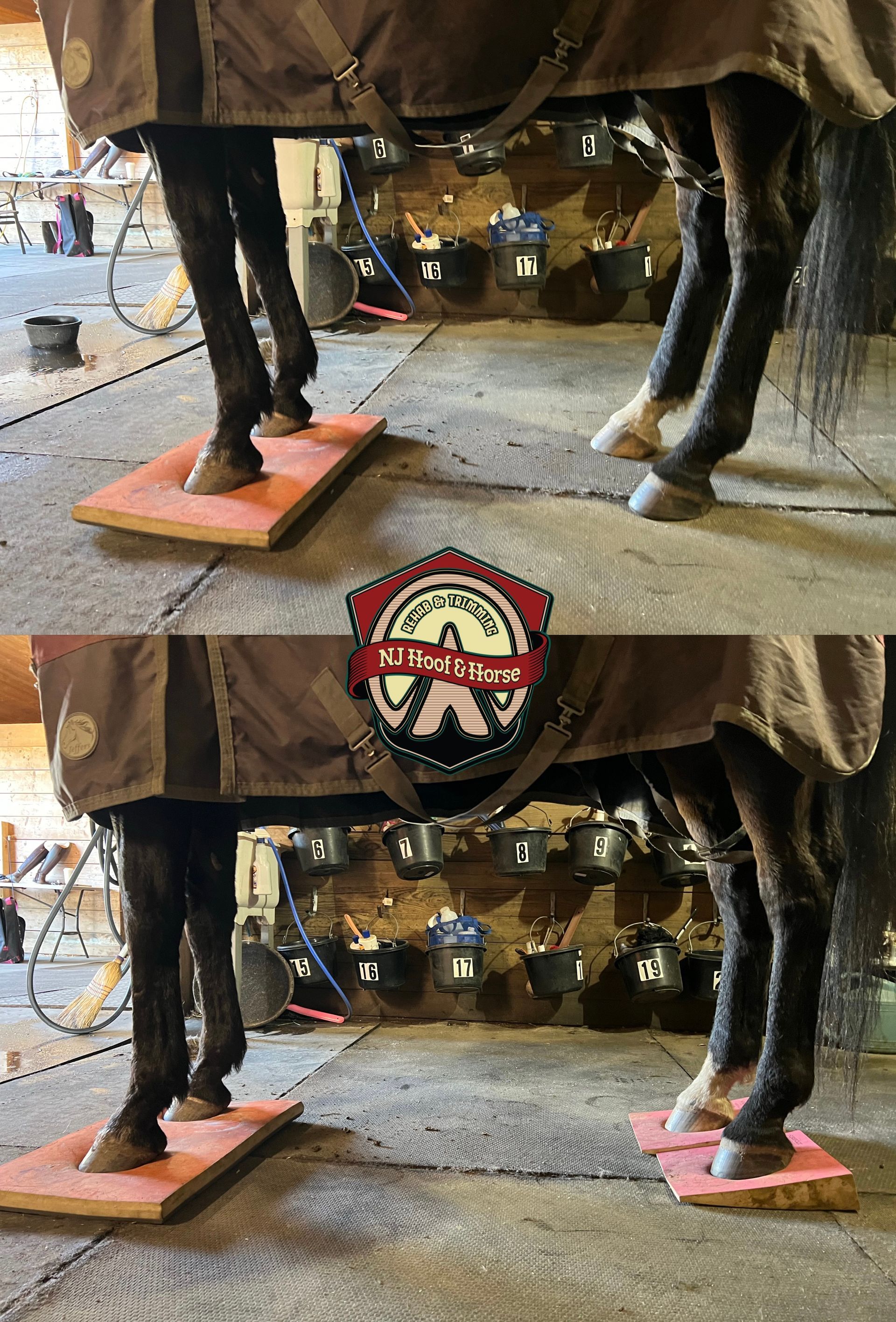
The last post on my Facebook Group sparked many opinions as to whether wedges (especially hind wedges) are the “root of all evil” or the “cure for everything.” Also, there was confusion as to WHY I put this horse on the Surefoot pads (both hind and front) and why the abrupt change in posture happened.
Let’s decipher why the horse changed his posture when I added hind wedges. -
Due to a common occurrence of horses getting long toes in the fronts, their perceptual reaction to this is to lean forward. Add to that the fact that the head accounts for about 10% of the horse’s entire bodyweight, and you can see why they find themselves leaning. In order for the horse not to “face plant” on the ground, the hind end counterbalances this postural issue. The horse brings the hind end more under themselves, resulting in a stance that Dr. Judith Shoemaker famously calls “Goat on a Rock.”
What happens when we stand the horse on Surefoot pads? -
The density of the meticulously designed pads allows the horse to load the hoof as it wants to. The pads allow us to see how the HORSE wants to stand, not how the FARRIER wants the horse to stand. When I placed the pads under the horse, he CHOSE to stand square (as in the bottom picture) and stayed that way for 10 minutes while ground-tied. He felt more comfortable standing square. A square stance reflects a neutral, balanced posture with even limb loading and minimal degenerative strain and stress on the body.
But should we make trimming and shoeing decisions based on a horse’s posture while standing, or should it solely be based on how the horse moves? -
My answer: BOTH! And while we may not like to admit it, domesticated horses spend far more time standing than moving. We HAVE to take stance into consideration when making shoeing/trimming decisions. I am NOT belittling the assessment of horses in motion. I’m simply pointing out that neither can be ignored, and neither should be the only metric. It’s NOT linear.
So what steps did I take to help the gelding? -
I knew that getting rid of the long toes in the fronts was essential to break the degenerative posture pattern. That was the beginning step. The gelding also had thin soles and underdeveloped frogs on the fronts. The owner and I decided on applying glue-on shoes with dental impression material on the fronts. Within a couple of weeks, the gelding showed an improvement at a walk AND in stance. He started standing square in his paddock. His gait improved. He wasn’t showing body discomfort.
The big question is: What clues did the horse’s behavior on the pads give me, and how could I implement it in my shoeing and trimming? -
Why did the gelding immediately stand square when I applied the wedge pads on the hinds? Because doing that helped him bring his P3 to the plantar angle HE wanted, as well as relieve the strain he had on his hind end due to poor posture. I used that as INFORMATION. So Surefoot pads give us INFORMATION. Our goal is to decipher it.
I knew that his hind toes were not only long, but also tall. Hinds distort differently than fronts. Hind feet tend to grow a taller toe, more in vertical depth, which often results in a negative plantar angle and a parked-under stance. So I trimmed his hind toe HEIGHT, which brought his hind feet back to a square stance.
Trimming is subtractive. We can only take AWAY material; we can’t ADD. There are times when the trim is more than enough for the horse to gain comfort. There are other instances when we have to add prosthetic devices to the foot. I felt that the gelding’s front feet required more intervention with prosthetic devices, while the hinds could stay comfortable with a better trim. It worked.
Do wedges hurt more than they help? -
It all depends on the timing and application of the wedge. In my own practice, wedges used with proper caudal support have produced excellent results without crushing heels or creating new problems. Dental impression material that I use to build wedges acts as a stimulant, helping the heel expand and contract, resulting in improved blood flow and better growth.
We can’t ignore the fact that wedges have helped countless horses, and they’ll continue to do so. At the same time, using them at the wrong moment or without the right strategy can create setbacks. That’s why input from a skilled team—farrier, vet, bodyworker—makes such a difference when deciding what the horse needs.
The gelding is being ridden and is sound!
In the meantime, stay open to new ideas and keep widening your perspective. The more you broaden your horizons, the more horses you’ll be able to help.
Denys A.
www.njhoof.com